
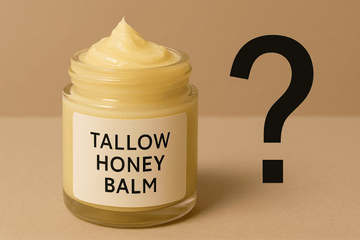
Those dreamy tallow-honey balms all over your feed look gorgeous — but the beeswax and olive oil that make them so creamy are exactly what clogs acne-prone pores. The version your skin actually thanks you for is simpler: pure grass-fed tallow, whose fatty-acid profile is the closest match to your own skin oil of any common fat. It calms breakouts and feeds your skin without ever blocking a pore. Still want honey? Use it the way it truly works — as a quick mask on its own.

Your acne-safe hero
Tallow + Jojoba Minimalist Butter
Just grass-fed tallow and jojoba — no beeswax, no olive oil, no fragrance. Both mirror your skin's own oil, so they feed breakout-prone skin without clogging a single pore. Our award-winning, lowest-risk hero.
Shop the Minimalist ButterFree shipping
€75 · Belgium, Netherlands, Germany, France
€85 · EU, UK & Ireland
€100 · US & Canada
Why tallow is a dream for acne-prone skin
Beef tallow is one of the oldest skincare ingredients there is — and it's back because it simply works. Its fatty-acid profile is the closest match to your own skin oil of any common fat, around 55%, versus 40% for shea, 35% for olive and just 23% for coconut. So it feeds your skin deeply without clogging pores or stinging. Rich in vitamins A, D, E and K, it strengthens the barrier and calms the inflammation behind so many breakouts. For sensitive, reactive, acne-prone skin it can feel like an exhale: no tightness, no dryness — just calm, hydrated skin that can finally breathe.


Real skin, before and after switching to clean tallow — tap to explore the range.
“The best product I've ever purchased for my skin — I'm 35, with sensitive, acne-prone, rosacea-prone skin.”
Danielle · review via Judge.me
What tallow really does for breakouts
As a health coach, here's the truth I want you to have: breakouts — especially the deep, cystic kind — are driven by inflammation, hormones and your cycle, so no single balm cures them. What good tallow does, and what I see again and again, is calm the skin so there's less inflammation, rebuild a stronger barrier, and help your oil settle — so skin heals faster and with less scarring. That's the real win, and it's why I keep our formulas gloriously simple.
— Laura, founder of Nana Latta
Honey in skincare: sweet, and a little misunderstood
Honey is another ancient remedy that keeps showing up in acne products — and for good reason. Raw honey is antibacterial, anti-inflammatory and a natural humectant that pulls moisture into the skin. But here's what those honey-balm ads leave out: honey is water-soluble. To truly get its benefits, it needs to touch clean, damp skin directly — not sit trapped in a thick, oil-based balm where it can't do its job.
The honey mask ritual
The best way to enjoy honey is still the simplest. Grab a jar of raw, unprocessed honey — the kind made for eating — and give yourself fifteen minutes:
- Gently cleanse and pat dry.
- Smooth a thin layer of raw honey onto damp skin.
- Leave on for 15–20 minutes.
- Rinse with lukewarm water and pat dry.
Soothing, balancing, and yours to keep — just patch-test first if honey is new to your skin. Then don't skip the step that seals it all in: a clean, breathable tallow layer to lock that hydration down.
We love our international clients 🌍
Reading from the US or Canada? We ship worldwide from Belgium, with free shipping to the US & Canada on orders over €100. Every jar is handmade under EU cosmetic law, which bans more than 1,600 ingredients still permitted in the US — a short, clean list is exactly what acne-prone skin has been waiting for.
Why most tallow honey balms aren't ideal for acne
Most trending tallow-honey balms hide more than two ingredients. To get that creamy scoop, brands add beeswax and olive oil — marketed as natural and nourishing, but not friends to acne-prone skin. Beeswax forms a thick layer that traps oil, bacteria and sweat against skin that's already struggling. Olive oil is antioxidant-rich but ranks high on the comedogenic scale, so it can block pores. Lovely for lips and dry elbows — but for breakouts, not the one.
| Ingredient | Comedogenic | Match to sebum | Best for |
|---|---|---|---|
| Tallow | Low (~2/5) | ~55% | Acne-prone, sensitive, all skin types, daily use |
| Raw honey | Low (water-soluble) | n/a | A weekly antibacterial mask, applied alone |
| Beeswax | Moderate | n/a | Lip balm, dry elbows — not facial acne care |
| Olive oil | High | ~35% | Body use, cooking — best avoided on acne-prone faces |
What this means for your skin type
Oily & acne-prone
Start with the unscented Minimalist Butter — its close match to your own oil helps rather than adds to shine.
Sensitive & reactive
Family Daisy's chamomile is gentle enough for skin that reacts to almost everything.
Dry, acne-prone
The Minimalist Butter handles dryness without the heaviness of beeswax or olive-oil balms.
Mature, acne-prone
Fancy Rose's bakuchiol supports renewal while the tallow base respects a breakout-prone complexion.
Bring tallow home
Find your clean tallow match
No beeswax, no olive oil — just clean tallow. Handmade in Belgium, prices shown in your own currency at checkout.


Want all three together? Try the Face Trio.
Ready when you are
Get 10% off your first order
Skip the pore-clogging balms and give breakout-prone skin the clean tallow it recognises — plus first access to our small-batch restocks. Handmade in Belgium.
Claim 10% offFrequently asked questions
Can tallow help with acne?
For a lot of people, yes — beautifully. Tallow's fatty-acid profile is around 55% similar to your own oil, so it nourishes without triggering excess grease, and its anti-inflammatory fatty acids calm the redness behind breakouts. It's not a magic overnight cure, so give it a few weeks of daily use and patch-test first.
Is beeswax bad for acne-prone skin?
It's not ideal. Beeswax creates a thick occlusive layer that can trap oil, bacteria and sweat against the skin. Fine for the odd dry patch, best kept off breakout-prone faces.
Should I use raw honey directly on my face for acne?
Yes — raw, unprocessed honey on clean, damp skin is a gentle, traditional way to use its antibacterial and anti-inflammatory properties. Apply, leave 15–20 minutes, rinse well. Always patch-test first.
What makes the Minimalist Butter better than a honey balm for acne?
The Tallow + Jojoba Minimalist Butter is only grass-fed tallow and jojoba — no beeswax, no olive oil, no fragrance. Both are low-comedogenic and mirror your skin's own oil, so they genuinely suit acne-prone skin without clogging a pore.
Do you ship to the US and Canada?
Yes — we ship worldwide from Belgium, with free shipping to the US and Canada on orders over €100. Prices show in your own currency and shipping is calculated at checkout.
Related reads
- Does Beef Tallow Help Acne? The Honest Answer
- Why Jojoba Oil Is Your Skin's Best Friend for Acne and Oily Skin
- Tallow Benefits for Dry, Sensitive and Acne-Prone Skin

Laura, founder of Nana Latta
Formula Botanica-trained skincare formulator and health coach, founder of Belgium's first tallow skincare brand — grass-fed tallow, made by hand.


