
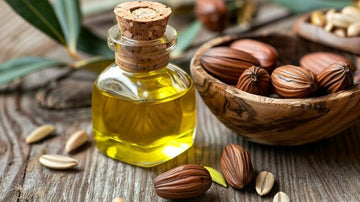
Picture oily, breakout-prone skin that finally behaves — calm, balanced, soft, with no midday shine. That's jojoba's quiet superpower. It's the one plant oil your skin actually recognises as its own, so it melts in, gently tells overworked oil glands to stand down, and won't clog pores. Blended with grass-fed tallow in our Minimalist Butter, it's the two-ingredient jar people tell us replaced everything else on their shelf.

The jar people don't stop using
Tallow + Jojoba Minimalist Butter
Two ingredients, fragrance-free: grass-fed tallow to feed your skin, jojoba to balance sebum and keep it breathable. Calmer, softer, shine-free skin from one little jar.
Discover the Minimalist ButterMade by hand in Belgium
Ships worldwide · free shipping available, calculated at checkout · prices in your own currency
“Incredibly creamy and my skin absorbs it really well. I'm 33 with acne-prone skin and it works great — I use it on my face and my whole body.”
Eni · review via Judge.me
Build your calm, clean routine
Skin food, in one jar
Start unscented, add a gentle non-stripping cleanse, or calm reactive skin with chamomile — all handmade in Belgium.


If you struggle with acne or oily skin, you've been told oils are the enemy. The opposite is often true: the right oil is the thing that finally calms your skin down. Jojoba is skin food your face actually recognises — you can see how it sits alongside tallow and the rest of our short ingredient list in our ingredient library — and paired with our tallow it's one of the gentlest, most forgiving things you can give skin that's been let down by one too many products.
Why jojoba balances oily skin
Jojoba (pronounced ho-HO-bah) behaves unlike any other plant oil: its make-up is remarkably close to human sebum, the oil your own glands produce, so your skin treats it like family instead of a foreign invader to fight off. That's exactly why it's so good at balancing sebum — your skin reads it as “already moisturised” and eases off overproducing. A dermatology review describes this sebum-like makeup alongside soothing, anti-inflammatory properties (jojoba in dermatology, PubMed), and broader work on plant oils groups jojoba among those valued for supporting the skin barrier (natural oils for skin-barrier repair, Int J Mol Sci). That's what “biocompatible” really means: your skin recognises it, drinks it in, and calms down.

I trained at Formula Botanica and tested a lot of oils while building these formulas. Jojoba won its place in our Minimalist Butter for one reason: the feeling. That perfect slip, the way it disappears into the skin, the silky finish with zero shine — the balance I wanted for reactive, eczema-prone, acne-prone skin, and for families who want one fragrance-free thing they can trust on everyone. — Laura, founder
Jojoba for acne-prone skin
Here's the myth worth dropping: oily skin does not need to be dried out. Strip it, and it panics and pumps out more oil — hello, more breakouts. Jojoba does the opposite. It reassures your glands that skin is already moisturised, so they ease off. Less a product fighting your face, more a quiet conversation that ends the tug-of-war.
- Won't clog pores: jojoba is lightweight and sebum-like, so it balances on the surface rather than sinking in to block pores the way heavier oils can.
- Loved by blemish-prone skin for generations: a long, well-documented track record for oily and breakout-prone skin.
- Naturally soothing: the dermatology literature above notes anti-inflammatory properties, traditionally prized for calming reactive skin.
- Balances oil over time: with regular use, skin tends to settle into a calmer, less-shiny normal.
Jojoba vs other common oils
Each oil has its place — but for oily and acne-prone faces, jojoba and tallow are in a league of their own. (Sebum-match figures below reflect fatty-acid similarity commonly cited for each fat.)
| Oil | Comedogenic | Match to skin's own oil | Best for |
|---|---|---|---|
| Jojoba | Non-comedogenic | Very close structurally | Oily, acne-prone, combination |
| Tallow | Low | ~55% | All skin types — nourishment & barrier |
| Coconut oil | High | ~23% | Body — often too rich for acne-prone faces |
| Olive oil | High | ~35% | Body, cooking — best off acne-prone faces |
Ready when you are
10% off
your first order, plus first access to our small-batch restocks.
Claim 10% offWe love our international clients 🌍
Reading from the US or Canada? We ship worldwide from Belgium — prices in your own currency, shipping calculated at checkout, with free shipping available. Every jar is handmade under EU cosmetic law, which bans more than 1,600 ingredients still permitted in the US — a short, clean list is exactly what oily, reactive skin has been waiting for.
Jojoba + tallow: skin food in one jar
This is where it gets good. We blend jojoba with grass-fed, upcycled beef tallow in our Tallow + Jojoba Minimalist Butter, and the two are a perfect pair: tallow feeds your skin deep nourishment and the fat-soluble vitamins A, D, E and K, while jojoba balances sebum and keeps oil in check without ever suffocating your pores. It's the closest thing to handing your skin exactly what it already knows how to use — your skin, coming home to itself. Fragrance-free and minimal, it's built for the sensitive, reactive, acne-prone skin that reacts to everything else.
What this means for your skin type
Oily skin
Jojoba balances sebum instead of stripping it — make the Minimalist Butter your only moisturiser, morning and night, and watch the shine settle.
Acne-prone skin
Non-comedogenic and calming, it works with your breakouts, not against them. Give it the full four to six weeks.
Sensitive & reactive
Two ingredients, no fragrance — almost nothing for reactive skin to react to.
Combination skin
It balances oily zones and dry patches at once, so you can retire the two-product routine.
How to use it
Smooth a little onto clean, slightly damp skin, morning and night. A pea-sized amount covers your whole face — this jar lasts. Give your skin four to six weeks to find its calm; skin that's been through a lot rewards a little patience with a glow that stays.
“The best product I've ever purchased for my skin — I'm 35, with sensitive, acne-prone, rosacea-prone skin.”
Danielle · review via Judge.me
Frequently asked questions
Is jojoba oil good for acne?
For many people, yes — it's one of the best. Because it mirrors your skin's own sebum, it helps balance oil instead of adding to it, and its non-comedogenic nature means it won't clog pores. It has a long, trusted track record for blemish-prone skin.
Can jojoba oil make acne worse?
Used well, pure jojoba tends to settle skin rather than upset it — most people see it calm down over a few weeks as their routine gets simpler. If your skin ever reacts instead of adjusting, ease off and patch-test.
What's the difference between jojoba and tallow for skin?
Jojoba is a lightweight, sebum-balancing oil that keeps skin breathable; tallow is a nutrient-dense fat, rich in vitamins A, D, E and K, that deeply nourishes and rebuilds the barrier. Together they do the whole job — balance and nourishment in one step.
How often should I use jojoba on my face?
Once or twice a day, on clean, slightly damp skin. Our Tallow + Jojoba Minimalist Butter is happy as your only moisturiser, morning and night.
Is the Tallow + Jojoba formula good for sensitive skin?
It's one of our best for it. The butter is unscented with just two clean ingredients — no synthetic fragrance, preservatives or fillers — so sensitive, reactive, acne-prone skin has almost nothing to react to.
Related reads
- Does Beef Tallow Help Acne? The Honest Answer
- Tallow and Honey Balm for Acne: Helpful or Hype?
- Tallow for Rosacea: Does It Help or Hurt?

Laura, founder of Nana Latta
Formula Botanica-trained skincare formulator and health coach, founder of Belgium's first tallow skincare brand. I tested many oils by hand before jojoba earned its place — and I still make every batch by hand.


