
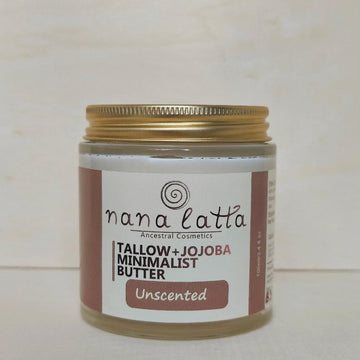
Short answer: imagine one jar that finally suits your skin — dry skin that stays comfortable all day, sensitive skin that stops flaring, breakout-prone skin that calms down. That's what makes tallow unusual: its fatty-acid profile is remarkably close to human sebum (~55%), so instead of working for just one skin type it tends to work across dry, sensitive and acne-prone skin. It hydrates without needing water, supports the skin barrier, and sits low on the comedogenic scale (~2/5) next to many plant oils. Start with a pea-sized amount and give reactive skin two to four weeks to settle.

Start with the simplest formula
Tallow + Jojoba Minimalist Butter
Fragrance-free with just two ingredients — the lowest-risk way to see how your own skin responds, whether it's dry, sensitive or acne-prone.
Meet the Minimalist Butter · €28,90 →Ships worldwide from Belgium · free shipping available, calculated at checkout
Close to your sebum
~55% like human skin oil — recognised, not walled off.
Barrier support
Helps limit moisture loss and comfort a compromised barrier.
Low comedogenic (~2/5)
Similar to jojoba — far below coconut oil (~4).
Works across skin types
Dry, sensitive, acne-prone and mature — patch-test first.
Tallow is a natural fat rendered from beef and carefully purified into a deeply nourishing skincare ingredient. At Nana Latta we embrace it for both its ancestral roots and its documented skin benefits: it hydrates without clogging most people's pores, supports the skin barrier, and works alongside the skin's own repair processes — one of the more complete ingredients you can use on its own.
The history of tallow in skincare
Tallow has been used across human civilisations for millennia. From Roman bathhouses to Victorian beauty rituals, animal fats were foundational to natural skincare. In ancient Egypt they shielded skin from sun and dryness; in Northern Europe, tallow and lard protected skin through harsh winters.
It wasn't until synthetic ingredients rose in the 20th century that these traditional remedies were sidelined — driven by industrial cost and scale, not by evidence that the alternatives worked better. What's striking is how consistently unrelated cultures arrived at the same answer: the Inuit rendered seal and caribou fat in the Arctic, where no plant oils exist at all, while European apothecaries built salves on tallow and lard for centuries. That kind of independent convergence isn't proof of a mechanism, but it's a strong signal that something real was being observed and repeated for a reason.
The nutrient profile of tallow
Tallow is rich in fatty acids that closely mirror the lipids of human skin — palmitic, stearic and oleic acid — known to support barrier function and help limit moisture loss. It also carries fat-soluble vitamins A, D, E and K. Because these fats resemble what skin already produces, they tend to be absorbed rather than sitting on the surface.
Each fatty acid does slightly different work. Stearic acid is documented as having a mild anti-inflammatory effect, part of why tallow moisturisers are often reported to calm redness. Palmitic acid is the single most abundant fatty acid in human sebum, which helps explain why skin recognises and absorbs it. Oleic acid improves how well other lipids penetrate — though it's also the one researchers watch most closely, since very high concentrations on already-compromised skin have been linked to barrier disruption. Tallow's balance of all three, rather than an overload of any single one, is part of what sets it apart from an oleic-heavy oil like olive oil.
The fat-soluble vitamins add a second layer. Vitamin A (retinol precursors) is one of the best-studied compounds for supporting cell turnover — the same vitamin family behind prescription retinoids, delivered here in its naturally occurring, lower-concentration form. Vitamin E is a well-documented antioxidant. Vitamins D and K are present in smaller amounts and less independently studied for topical use, so we'd rather name that gap honestly than imply more certainty than exists.
Start with the simplest formula
Our Tallow + Jojoba Minimalist Butter (€28,90) is fragrance-free with just two ingredients — a good way to see how your skin responds before adding anything else.
Shop the Minimalist Butter →Tallow for different skin types
- Dry skin: tallow's rich fat content helps form a barrier against moisture loss, giving lasting relief for very dry skin — the Minimalist Butter works well as a standalone.
- Sensitive skin: free from synthetic additives and fragrance in our unscented formulas, tallow is generally gentle and unlikely to trigger reactions — Family Daisy's chamomile formula was built for this.
- Acne-prone skin: its sebum-like profile means many people find it doesn't add to congestion the way heavier plant oils can. Generally well tolerated, though patch-testing is worth doing — start with the unscented Minimalist Butter.
- Mature skin: the fat-soluble vitamins A and E are well-documented for cell turnover and antioxidant protection — a tallow-bakuchiol blend like Fancy Rose is a gentle, retinol-free option.
Tallow vs. plant-based moisturisers
Tallow's structure lets it absorb without the greasy residue some plant oils leave, and its similarity to human sebum is one reason it's absorbed differently than many plant alternatives. This isn't a claim that plant oils are bad — jojoba is a genuinely close match to sebum in its own right, which is exactly why we pair it with tallow. What matters is the fat's structure relative to skin's own chemistry, not "animal versus plant" as a blanket rule. Coconut oil is the useful counter-example: entirely plant-derived, widely marketed as nourishing, yet high on the comedogenic scale. The table reflects independently reported ratings and sebum-match research, not a brand preference.
| Fat / oil | Match to sebum | Comedogenic (0–5) | Best for |
|---|---|---|---|
| Tallow | ~55% | ~2 (low-moderate) | Dry, sensitive, acne-prone, mature |
| Shea butter | ~40% | ~0–1 (low) | Dry skin, lighter finish |
| Olive oil | ~35% | ~2 (moderate) | Body use, less ideal on acne-prone faces |
| Coconut oil | ~23% | ~4 (high) | Body use — often avoided on acne-prone faces |
How to introduce tallow into your routine
Switching from a water-based moisturiser, the texture takes a little adjustment. A pea-sized amount goes further than most people expect — tallow is concentrated, and a thin layer is usually enough for the whole face. Warming it briefly between your fingertips helps it spread evenly. It works as either the whole routine or the final step: there's no need to layer it under other products, since its job is to seal in moisture and support the barrier. Give it two to four weeks before judging, particularly for acne-prone or reactive skin adjusting from stripping cleansers — a short recalibration of the skin's own oil production is commonly reported and isn't a sign something's wrong.
Before you go
Get 10% off your first order
New to tallow? Join our list for 10% off your first order, plus honest skincare notes and first access to small-batch restocks. No noise, just tallow made by hand in Belgium.
Claim 10% off →★★★★★
"Great help and tips on which tallow suits you best. Products work well, feel lovely — spread easily and absorb quickly. Top quality."
— Esmeralda, Belgium · verified review
Common myths about tallow
"Tallow clogs pores." This comes largely from the comedogenic scale itself, developed decades ago on a rabbit-ear model since shown to predict human skin poorly. Purified tallow generally scores low-to-moderate — comparable to jojoba — and skin tends to recognise it rather than wall it off. Still, "generally" isn't "universally," which is exactly why patch-testing matters more than any scale number.
"Tallow smells bad." Smell comes down to how it was rendered. Poor-quality tallow — high heat, lower-grade fat — can smell meaty. Properly cold-processed tallow from clean suet is close to odourless. If you've smelled tallow that put you off, it was very likely a quality issue, not the ingredient itself.
"Tallow is only for dry skin." Its richness makes it an obvious fit for dryness, so that's the use case people talk about most. But the same barrier-compatible fats mean it doesn't sit heavily or trigger the oil-overproduction cycle that worsens oily and acne-prone skin over time — which is why it appears across the skin-type breakdown above.
"Tallow is outdated." Outdated implies something better replaced it. What actually happened is that synthetic, petroleum-derived ingredients became far cheaper at industrial scale in the mid-20th century. Tallow didn't stop working — it stopped being the cheapest option for mass manufacturers, which is a different thing entirely.
Where our tallow comes from
Tallow is a by-product of the beef industry — fat that would otherwise be discarded. Using it in skincare doesn't require raising additional animals; it makes use of something that already exists, which is part of why we see it as one of the more genuinely low-waste choices in natural skincare.
Our tallow is grass-fed and cold-rendered by a Belgian family company that has been working with fats since 1815, seven generations and more than two centuries. It is food-grade and halal-certified, purified with natural clay, with no chemical bleaching. Grass-fed tallow tends to carry more monounsaturated fat and a higher concentration of fat-soluble vitamins than grain-fed, since diet shapes the fat's composition. Cold rendering preserves more of that profile and avoids the meatier smell high-heat processing leaves behind. Every Nana Latta product is handmade in small batches in Belgium under EU cosmetics regulation — among the strictest in the world.
Find your match by skin type
Not sure where to start? The Face Trio pairs three bestselling tallow butters — a lovely place to begin.


Related reads
- What Is Tallow? From Origins to Benefits
- How to Use Tallow in Your Skincare Routine
- Is Tallow Skincare a Scam? Every Reddit Objection, Answered Honestly
Frequently asked questions
What exactly is tallow?
Tallow is a purified natural fat rendered from beef, traditionally processed using gentle cold-method techniques that preserve its nutrient profile — fat-soluble vitamins A, D, E and K and fatty acids like palmitic, stearic and oleic acid.
Is tallow safe for the face?
Generally, yes. Its composition is close to human sebum, it's low-to-moderate on the comedogenic scale, free from synthetic irritants in our unscented formulas, and used across skin types including sensitive and acne-prone. Patch-test first if your skin is reactive — the unscented Minimalist Butter is the lowest-risk start.
Does tallow clog pores?
For most people, not significantly. High-quality tallow scores low-to-moderate on the informal comedogenic scale, similar to jojoba oil, because its fatty-acid profile is close to human sebum. Individual results vary, so patch-testing is still worth doing.
What is the difference between tallow and beef tallow?
Tallow can technically be rendered from any ruminant animal fat; "beef tallow" specifically refers to fat from cattle. At Nana Latta we use grass-fed beef tallow: cold-rendered by a Belgian family company in business since 1815; food-grade, halal-certified, purified with natural clay, no chemical bleaching.
How long does it take to see results?
Most people notice a difference in hydration and comfort within one to two weeks. For acne-prone or reactive skin adjusting from stripping cleansers or heavy synthetic products, give it closer to four weeks — the skin's own oil production can take that long to recalibrate, and quitting too early is a common reason people miss the benefit.

Written by
Laura, founder of Nana Latta
Formula Botanica-trained skincare formulator and founder of Belgium's first tallow skincare brand. I formulate for dry, sensitive and acne-prone skin alike — and I make every batch by hand.


